My Master's Research Project and indeed the BMC program has come to a conclusion. Without further ado, you can check out the full project here: http://bmc1.erin.utoronto.ca/~stuart/RIN/
Please watch the animation, (direct link: https://vimeo.com/70039214) and if you can spare a little more time, feel free to play with the simulator too. I don't expect non-biologists or neuroscientists to understand most or all of it, but hopefully the visuals and interactivity are interesting.
Here's a couple of stills from the animation at very large resolutions. Feel free to download and use as wallpapers etc. (Edit: Okay, blogger apparently has a max res of 1600 on the long edge. Send me an email if you want a larger version... up to 4K).
Now I get to acknowledge everyone like an Oscar speech!
Thanks to Nick, Yves, and Michael (my committee), to all the BMC faculty, my 13 BMC colleagues (very good friends all), members of Yves' lab, my non-BMC friends, all you people that read this blog, and of course my family and Rebecca and God.
Woohoo! Done! What's next? Looking forward to a conference next week that I'm presenting a poster at. I do have some job leads and there is industry day at the end of the month. I'll keep you posted. This blog isn't going anywhere; it's been a terrific outlet for me these past ~4 years and it will continue to be that.
Thanks again everyone, and I hope you continue to check in here and see what the next stage will bring.
Later,
Stuart
Showing posts with label RtIN. Show all posts
Friday, July 12, 2013
Wednesday, June 12, 2013
RIN - Neural environments
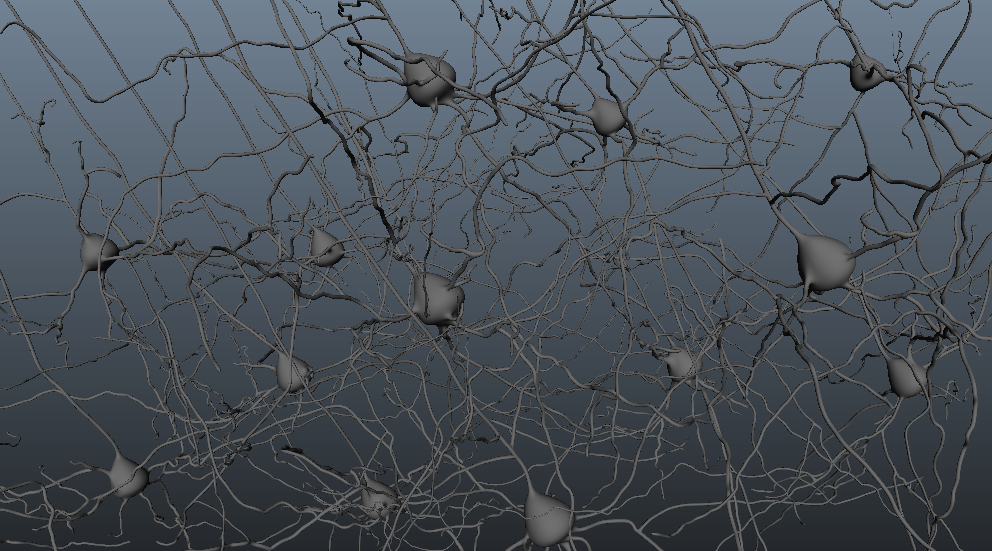
Here's a couple still frames from shots that are of the neural environment in my animation. I went through a number of iterations of texturing and lighting setups to try to get a feeling of a dark, heavily populated space. I'm using small particles, backlighting, and shallow DOF to try to get something of a aqueous micro-environment. The particles are very de-emphasized because they shouldn't draw attention to themselves, but they are a subtle part of the animation.
This shows the long apical dendrites of pyramidal cells with astrocytes and interneurons interspersed.
The probe allows for photoconversion of fluorescent molecules.
Pretty much exactly a month left. Tick tock.
Later,
Stuart
This shows the long apical dendrites of pyramidal cells with astrocytes and interneurons interspersed.
The probe allows for photoconversion of fluorescent molecules.
Pretty much exactly a month left. Tick tock.
Later,
Stuart
Sunday, May 26, 2013
RIN - Grooming
A couple more rendered stills. I've got the mouse all behaving and rendered and I'm fairly pleased with it. I wasn't sure how the "glass" idea would actually work with a fully animated mouse. I did have to do some animation tweaks and re-rendering to fix some strange refractive issues, but overall I think it is successful. You'll have to wait to see the animated version for your verdict, but here's a frame (with some motion blur) of some grooming.
And I've composited the microscope with some closeups showing the action in the scene.
Finally, I'm blocking out another shot that's ultimately going to have lots and lots of neurons. These are just some pyramidal cells so far. (Neuron Builder v0.91 worked pretty nicely for this).
I've currently got several shots in various stages of the pipeline, so this week I'm really hoping to tidy up loose ends and get production really focused. May is coming to a close and so I've got just about a month and a bit left in production.
Later,
Stuart
And I've composited the microscope with some closeups showing the action in the scene.
Finally, I'm blocking out another shot that's ultimately going to have lots and lots of neurons. These are just some pyramidal cells so far. (Neuron Builder v0.91 worked pretty nicely for this).
I've currently got several shots in various stages of the pipeline, so this week I'm really hoping to tidy up loose ends and get production really focused. May is coming to a close and so I've got just about a month and a bit left in production.
Later,
Stuart
Tuesday, May 14, 2013
RIN - Microscope rendered
Here's a render from the shot featuring the microscope. It is emitting light that will excite GFP in neurons in a thin slice of brain tissue. I still need to do some compositing on this shot, but it's pretty close to done.
I'm also currently rendering out my animated mouse. Here's a playblast of him moving around:
Later,
Stuart
I'm also currently rendering out my animated mouse. Here's a playblast of him moving around:
Later,
Stuart
Wednesday, May 8, 2013
RIN - Microscope model
For one of the shots I've doing this week, a thin slice of a mouse's brain will be examined under a microscope. This is one of if not the most complex model I'll be creating for my animation. I fortunately was able to find some great vector references for a Zeiss model (vector is the best when it comes to technical reference images). I modelled this over the past 2 days or so. I'm still experimenting with the best ways to present models. Something like this takes a bit of time to setup, render, and composite, but it looks a lot nicer than screenshots.
Clicken to embiggen.
Later,
Stuart
Clicken to embiggen.
Later,
Stuart
Saturday, May 4, 2013
RIN - Continued
Still working away at shots and simulator functionality. I've got three shots in the middle of the rendering phase. Unfortunately mental ray is giving me some trouble on a couple of them, so just working out kinks there. Meanwhile animating my mouse intro shot:
And the simulator is starting to come together as well:
Later,
Stuart
PS Apologies for the low quality jpegs. I just do that so my actual renders look a bit nicer in comparison. No, not really.
And the simulator is starting to come together as well:
Later,
Stuart
PS Apologies for the low quality jpegs. I just do that so my actual renders look a bit nicer in comparison. No, not really.
Thursday, April 11, 2013
RtIN - Mouse render
Work in progress render of my glass mouse. I'm liking how the brain looks, with a bit of wet-looking specular and subtle bump. Still need to work on the glass shader some and the whiskers. And the eye sockets.
Later,
Stuart
Thursday, April 4, 2013
Mouse and music
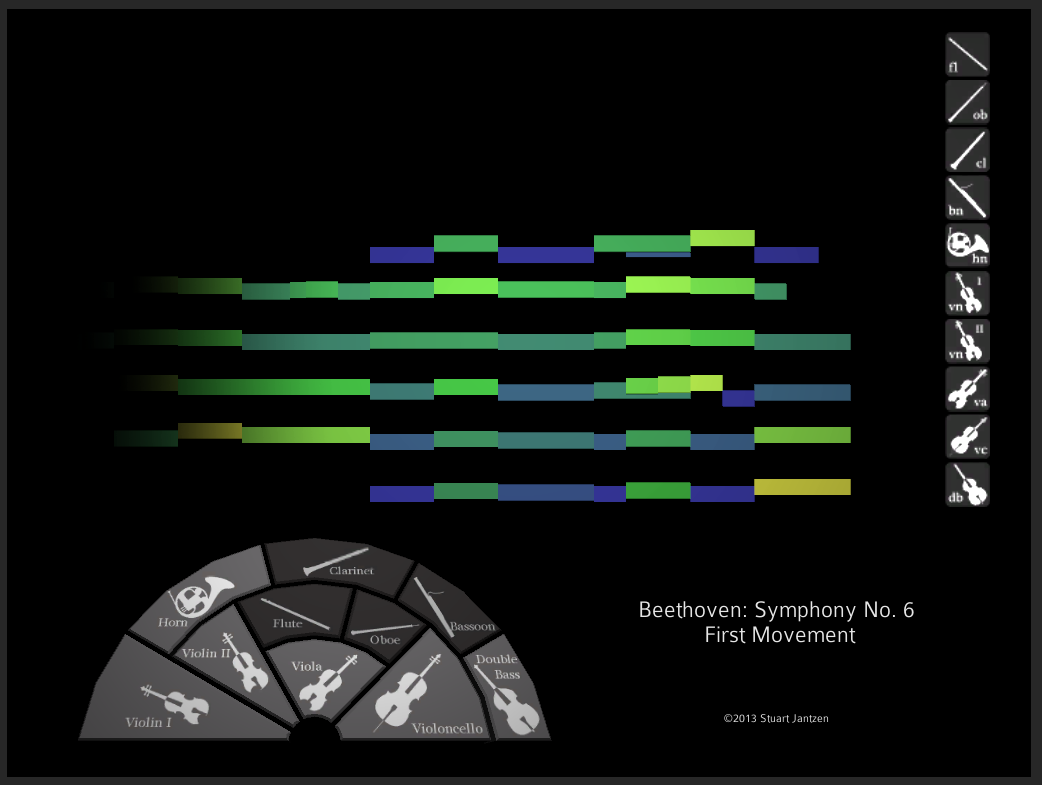
I presented my music visualization piece yesterday. It looks at a piece of orchestral music and creates a visual representation of the notes for each instrument as the piece plays (in MIDI format). I'd like to share the interactive app in the future, but it's a bit limited currently and difficult to distribute. So for now you'll have to be content with some screenshots and in the near future I'll upload a screen-capture of me using the program.
You can also click on the various instruments to visually filter them so you get a clearer picture of what is happening in the music.
I've also been working hard at modelling, UV mapping and now rigging my mouse. It's been challenging for sure, and there's still a ton of work left to do on it. Sculpt, texture, blend shapes, paint skin weights, animate, light, render and composite. I feel like I can't take any shortcuts either, because this is such an important character in the animation.
Later,
Stuart
You can also click on the various instruments to visually filter them so you get a clearer picture of what is happening in the music.
I've also been working hard at modelling, UV mapping and now rigging my mouse. It's been challenging for sure, and there's still a ton of work left to do on it. Sculpt, texture, blend shapes, paint skin weights, animate, light, render and composite. I feel like I can't take any shortcuts either, because this is such an important character in the animation.
Later,
Stuart
Tuesday, March 26, 2013
RtIN - Shot #4 and a headless mouse
Here's a still frame from the shot that takes place directly after the walking dynein. The fluorescence is transported along the axons towards the brain.
And I've started modelling a mouse which will be in quite a few shots, so I'm hoping it's going to be a decent looking mouse.
I've also been working hard on my music visualization project. I've managed to output cubes to represent Pachelbel's Canon. You can see the repeating structure in the bottom third which represents the repetitive cello line. Baaa bummm deee dummm. That one.
Busy times.
Later,
Stuart
And I've started modelling a mouse which will be in quite a few shots, so I'm hoping it's going to be a decent looking mouse.
I've also been working hard on my music visualization project. I've managed to output cubes to represent Pachelbel's Canon. You can see the repeating structure in the bottom third which represents the repetitive cello line. Baaa bummm deee dummm. That one.
Busy times.
Later,
Stuart
Monday, March 18, 2013
RtIN - Shot #3 video
Here's the animated version from my previous post. Hope you like it.
Later,
Stuart
Sunday, March 17, 2013
RtIN - Shot #3
Here's a still from my third shot, animated. It's partly an homage to "The Inner Life of the Cell", but in my animation, it's about how scientists can get fluorescent dye into specific neurons. Here a dynein molecule carries a vesicle loaded with fluorescent dye up an axon.
I'll probably upload this shot to Vimeo, since I think it's pretty neat. Stay tuned.
Later,
Stuart
I'll probably upload this shot to Vimeo, since I think it's pretty neat. Stay tuned.
Later,
Stuart
Thursday, March 7, 2013
RtIN - Second shot
The second shot I've rendered out for my neurophotonics animation shows a neuron firing as the probe enters the environment. It doesn't look very interesting to show an image of the electrical impulse, as it needs animation (and sound) to be believable. So that's why I'm only showing one still and no impulse.
I've gotten some good feedback on this shot from my professor, so I'll be making changes to the look and lighting for the final. But for now I'm working on another shot that takes place at the molecular scale.
I also recently scripted a very simple image plane creation tool, because I don't like using image planes attached to cameras, and it gets tedious to make a poly plane, scale it to the proper width and height, create new UVs, create a new material, add a file node into the color, and browse for the image file. This tool does most of that for you; you just have to enter the pixel width and height of your ref image, and after the plane is created, browse for the image file. If I was going to add more features, I would have a file browser at the get go, and try to read the pixel dimensions from there. But anyway, the script is here: http://bmc.erin.utoronto.ca/~stuart/resources.html (at the bottom of the page).
Later,
Stuart
I've gotten some good feedback on this shot from my professor, so I'll be making changes to the look and lighting for the final. But for now I'm working on another shot that takes place at the molecular scale.
I also recently scripted a very simple image plane creation tool, because I don't like using image planes attached to cameras, and it gets tedious to make a poly plane, scale it to the proper width and height, create new UVs, create a new material, add a file node into the color, and browse for the image file. This tool does most of that for you; you just have to enter the pixel width and height of your ref image, and after the plane is created, browse for the image file. If I was going to add more features, I would have a file browser at the get go, and try to read the pixel dimensions from there. But anyway, the script is here: http://bmc.erin.utoronto.ca/~stuart/resources.html (at the bottom of the page).
Later,
Stuart
Thursday, February 28, 2013
Neuron Builder v2.1 (actually v0.8) - WIP
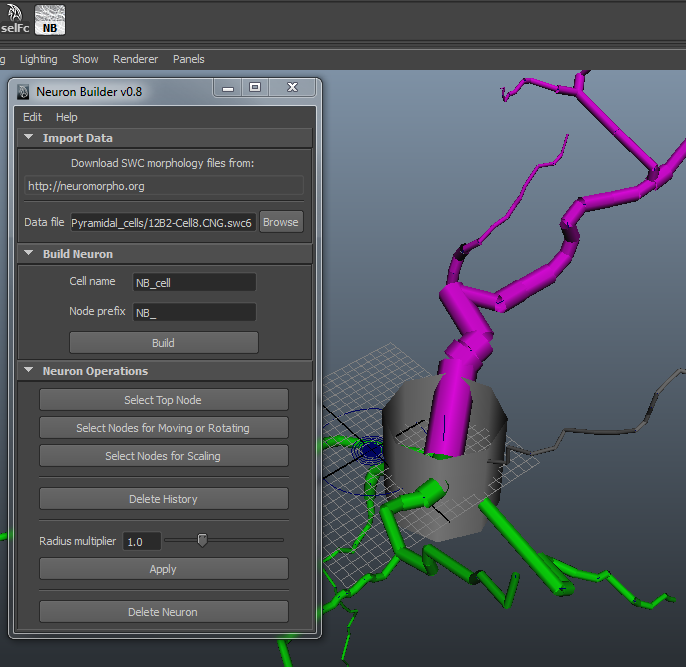
I've continued scripting the neuron builder I started in a previous post. I've had a lot of fun getting this thing working. It's one of the more satisfying things to hit enter and have thousands and thousands of commands execute spontaneously and immediately. I've posted some screenshots on facebook but if you're not on there, I'll drop them here too.
Color coding the various projections and soma based on the neuromorpho standards.
A simple interface to start off with.
Organize the hierarchy with some simple naming conventions and check if materials already exist so the hypershade doesn't get cluttered up unecessarily.
Clean up the interface and add a link to hypothetical documentation in the help menu.
Color coding the various projections and soma based on the neuromorpho standards.
A simple interface to start off with.
Organize the hierarchy with some simple naming conventions and check if materials already exist so the hypershade doesn't get cluttered up unecessarily.
Clean up the interface and add a link to hypothetical documentation in the help menu.
Add a radius multiplier to beef up tiny tiny dendrites. In retrospect, this wasn't that necessary, but it was a good exercise in learning some MEL.
And the current state of the situation. I've added the ability to input your own names and prefixes. There are some known issues and bugs, so I won't release it to the public yet. I'd also like to implement some more functionality to make it that much more useful. Right now it's little more than a way to get the data into the scene to use as a template. I would like it to generate usable curves and perhaps even geometry.
Later,
Stuart
Tuesday, February 12, 2013
Neuron builder - v2 WIP
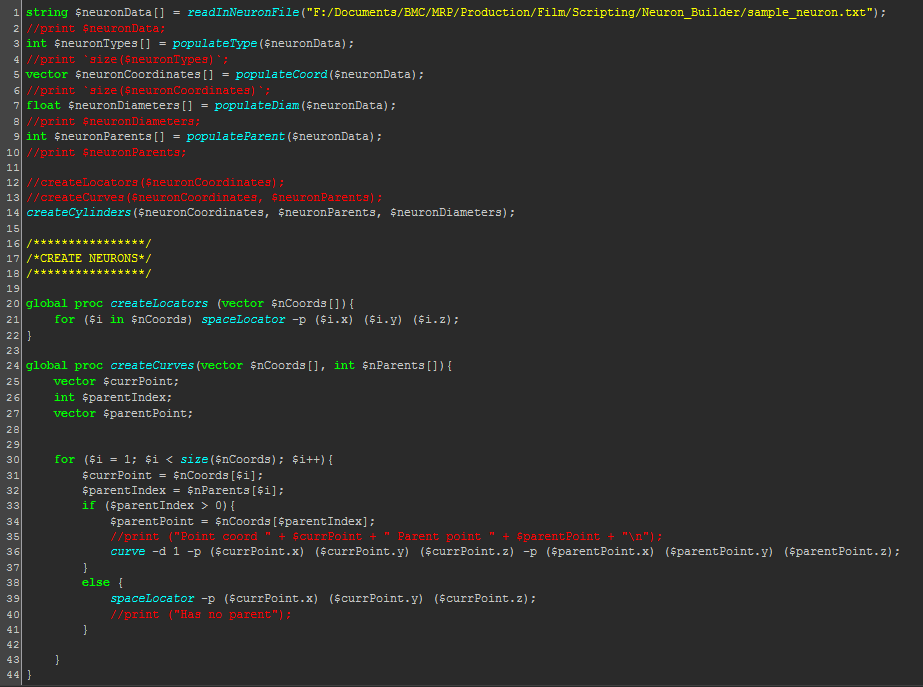
My supervisor showed me a type of data in a simple text format that encodes the branching structures of neurons. He thought it would be interesting to try to create a script that would import this data into Maya and build a 3D representation of it. I thought that was a neat challenge, since I was already trying to develop ways to procedurally model neurons.
This is where I'm at so far, creating simple cylinders from the data:
This is a section of the code. It's a bit tedious switching back and forth from MEL to Javascript for Unity, but I keep learning new things, and it's always satisfying to click a button and have hundreds of commands executed instantaneously.
Later,
Stuart
Tuesday, February 5, 2013
RtIN - First shot stills
I've rendered out the first shot (not the shot that comes first in the animation). Here are a couple of stills from it. I aimed for a high-key, clean laboratory feeling. Despite rather lengthy render times, I ended up with some aliasing problems, so I'll likely be re-rendering at some point in the future. For the time being, I'm moving on to the next shot so I can continue getting assets completed.
Later,
Stuart
Later,
Stuart
Friday, January 25, 2013
RtIN - Petri Dish
A petri dish! I've modelled a bunch of other stuff but I haven't rendered out any WIP images yet. I could post screenshots, but I kind of like the higher production look, even if it means I post less often. Sorry :(
Later,
Stuart
Later,
Stuart
Thursday, January 17, 2013
RtIN - Monitor
Production for "Recording the Illuminated Neuron" has officially begun (well a couple weeks ago) and I've gotten something of a start on modelling. I've spent a bit of time working on getting a WIP rendering system set up so it's easy for me to render out and post WIP images. Still lots of opportunity to tweak the system but I'm happy with the results so far using sIBL from hdrlabs.com.
I haven't decided whether I will want to post renders without wires or with, most of the time. Here are two with wires on top and one without.
Later,
Stuart
I haven't decided whether I will want to post renders without wires or with, most of the time. Here are two with wires on top and one without.
Later,
Stuart
Tuesday, December 11, 2012
MRP Animatic
As the semester comes to a close, I've decided to post my 2D animatic for the 3D animation in Maya I will be creating for my Master's Research Project. I suppose I still haven't explained my project so this is a good a chance as any.
DISCLAIMER: If you don't want to see my animation until its beautiful, 3D, final form, then don't watch the animatic. It's very visually rough, the narration is preliminary in my terrible voice, and everything is a spoiler for the final piece.
In February, I needed to start looking at selecting a project for my MRP, the main component of the MSc in Biomedical Communications I am pursuing. I saw a presentation on a very interesting new tool in neuroscience and chose it as the topic of study. The brief for this topic is to explain the function and usefulness of the newly developed probe to potentially interested parties, including researchers and graduate students. The "micro-optrode" represents the possibility for unprecedented (if I can use such a bold word) examination of individual neurons in living brains. For the time being, this research is being done on mice and rats. I will let the animatic (hopefully) explain the rest...
I will also be building an interactive simulator for the probe to be housed on a website along with the animation. Starting in January, I'll be in production for this animation.
Merry Christmas!
Stuart
DISCLAIMER: If you don't want to see my animation until its beautiful, 3D, final form, then don't watch the animatic. It's very visually rough, the narration is preliminary in my terrible voice, and everything is a spoiler for the final piece.
In February, I needed to start looking at selecting a project for my MRP, the main component of the MSc in Biomedical Communications I am pursuing. I saw a presentation on a very interesting new tool in neuroscience and chose it as the topic of study. The brief for this topic is to explain the function and usefulness of the newly developed probe to potentially interested parties, including researchers and graduate students. The "micro-optrode" represents the possibility for unprecedented (if I can use such a bold word) examination of individual neurons in living brains. For the time being, this research is being done on mice and rats. I will let the animatic (hopefully) explain the rest...
I will also be building an interactive simulator for the probe to be housed on a website along with the animation. Starting in January, I'll be in production for this animation.
Merry Christmas!
Stuart
Subscribe to:
Posts (Atom)